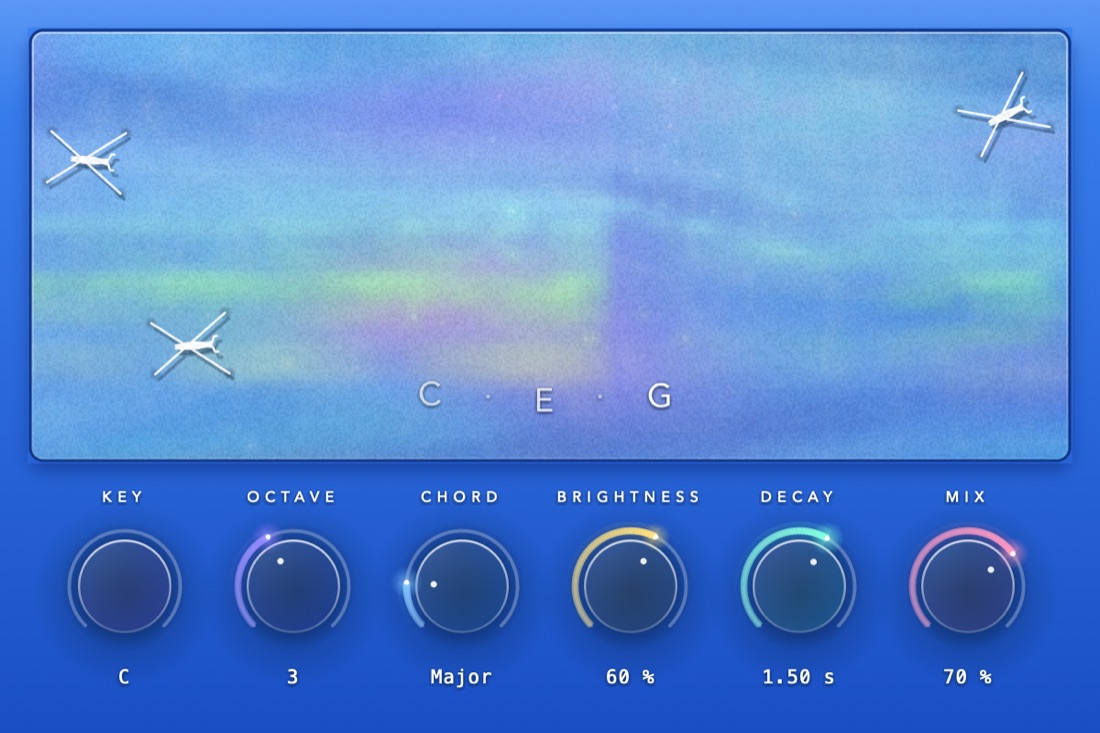
Waterfall
Comb filter resonator modelled on the SP‑404’s. Named after TAGABOW’s ‘behind the waterfall’.
Rings whatever you feed it through a chord. Six tuned resonators, one per chord tone, turn drums, noise and voices into pitched, shimmering chords, while a river spectrogram runs down the editor.
- Version
- 1.0.0
- Chords
- 12 voicings
- Root
- C-1 to G9
- Formats
- VST3 · AU · Standalone
Controls
6 parameters| Control | Range | Default | What it does |
|---|---|---|---|
| Key | C to B | C | The root note of the chord. |
| Octave | -1 to 9 | 3 | The root's octave, so the chord can sit anywhere from C-1 up to G9. |
| Chord | 12 voicings | Major | Unison, Fifth, Major, Minor, Sus2, Sus4, Maj7, Min7, Dom7, Add9, Min9 or Dim, each stacked as six tones above the root. |
| Brightness | 0 to 100% | 60% | The damping inside each resonator: low rings dark, high rings open. |
| Decay | 0.05 to 10 s | 1.5 s | How long the chord keeps ringing. |
| Mix | 0 to 100% | 70% | The dry sound against the ringing chord. |
How it works
Each chord tone is a tuned comb filter that the input sets ringing. Its loop is compensated for the damping filter inside it, so the chord stays in tune at any Brightness.
The six tones are panned and detuned in pairs by their place in the chord, which is where the width comes from. Each side gets an even share of low and high tones, so panning the track thins the chord rather than making one side brighter or sharper.
In the top octaves the upper tones fold down an octave at a time, so they stay in tune where a resonator can't ring that high. A soft limiter catches the build-up from long decays on loud, tonal input.
In the editor
- The riverA spectrogram of the output, flowing down the editor as it plays.
- Water stridersThey skate across the river while it plays. Right-click the river to turn them on or off; the choice is saved with the set.